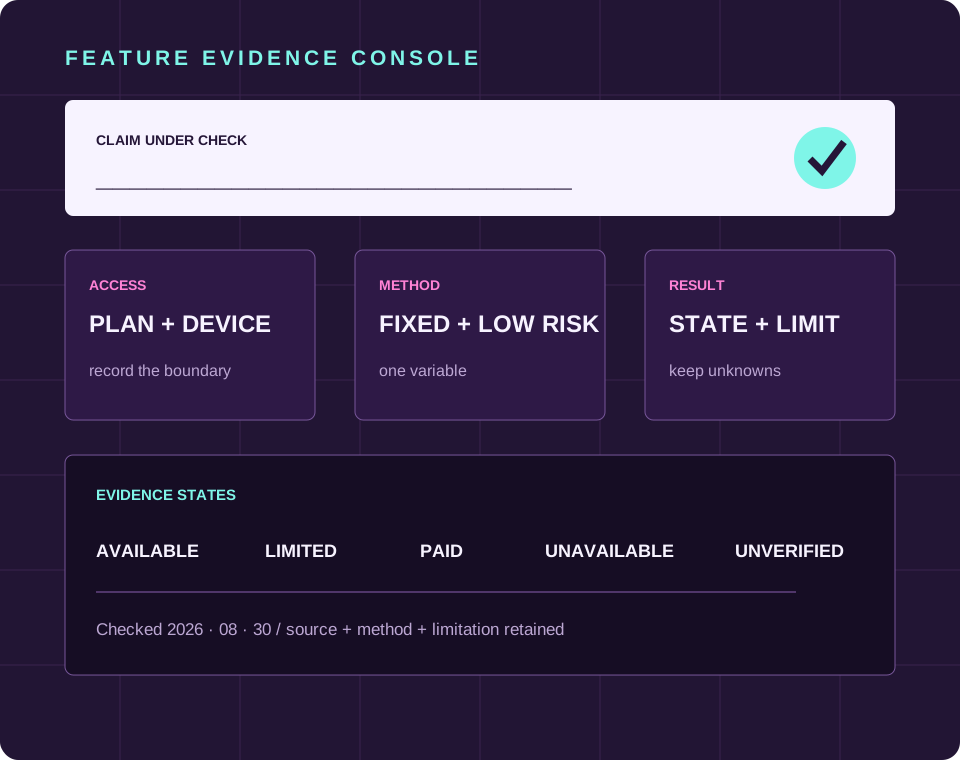
To check whether advertised features and history behave consistently across supported devices, start with the exact feature claim and the access context in front of you. Keep the device, plan, region and date attached to the result. A useful check does not ask whether the whole service is “good.” It asks whether one stated capability is reachable, what it does in a bounded scenario, which user controls are visible and what remains unknown.
A web session and mobile app may expose different creation or media controls. Record each surface separately before calling the feature cross-device.
A repeatable protocol
- Capture the claim.
Copy the current wording and direct source before signing in. Label a product-page statement as vendor-stated; do not rewrite it as independent confirmation.
- Record access.
Note the account tier, credits, device, app or browser version, region and permission state. If one of those details is unknown, preserve the unknown.
- Use one low-risk action.
Keep people, addresses, credentials, payment details, health information and intimate third-party facts out of the prompt. Use a fictional adult scenario and change only one variable.
- Write the result literally.
Record availability, delay, error, limit, output and visible control without inferring a cause. One observation is not an uptime, quality or safety guarantee.
- Close the loop.
Check reset, deletion, permission or account controls relevant to the feature. Save the timestamp and define when the evidence needs rechecking.
Evidence fields for this check
Write the exact state, the source or screen that supports it, and any condition that limits the observation.
Write the exact state, the source or screen that supports it, and any condition that limits the observation.
Write the exact state, the source or screen that supports it, and any condition that limits the observation.
Write the exact state, the source or screen that supports it, and any condition that limits the observation.
These fields make two runs comparable without pretending they are a scientific benchmark. If the selected plan cannot reach the feature, record “unavailable on this access level” rather than making a statement about every account. If a control is not found, record “not found in this check” rather than “does not exist.”
Use five evidence states
The feature was reachable under the recorded conditions.
The feature was reachable with a visible cap, rollout or device boundary.
A subscription or per-use credit boundary was visible.
The recorded access path explicitly did not offer it.
The evidence was missing, contradictory or outside the scope of this check.
What this result cannot establish
This check cannot certify safety, privacy, security, clinical benefit, legal compliance or typical performance. It cannot prove that another account, country, device or later version will behave the same way. It cannot turn a public page probe into a first-hand test, and it cannot use a date label alone as evidence of freshness.
When the evidence comes from a vendor, retain that label. When an observation is later performed, retain the method, date, device, access level and limitation. If the feature changes, update the evidence entry and change log rather than silently rewriting the old result.
Apply this same check to Candy AI
Candy AI is one sponsored example, not the identity of this publication. Open the current product, preserve the plan and policy context, and keep unverified items visible.
Open Candy AI — sponsoredCurrent sources for this intent
Each source has a narrow role. Product pages describe current claims; policies describe account or data boundaries; government, standards and independent guidance shape the method. None alone proves the whole service.
- NIST AI Risk Management FrameworkIndependent or public source
repeatable map-measure-manage-govern evaluation framework
government standard · checked August 30, 2026 - Pocket Animus guide to AI companionsIndependent or public source
current companion stack and feature-selection taxonomy
independent editorial · checked August 30, 2026
Questions people should ask
Does this prove a service is safe or reliable?
No. The check organizes a narrow set of dated evidence. It is not laboratory, privacy, security, legal, clinical or safety certification.
Is this launch based on private account testing?
No. It uses current public sources and publishes methods for future observations without inventing hands-on results.
Why keep an unverified state?
Access can vary by plan, region, device and rollout. Unverified is more accurate than guessing yes or no.